Department of Zoology, Wildlife & Fisheries

Dr. Muhammad Sajid Nadeem

Chairman

Ph.D. University of the Punjab

Email: [email protected]

Dr. Muhammad Sajid Nadeem

About Department

Humans have long been fascinated by a myriad of animals around them. Besides performing several services for the ecosystems, these animal species are of source of direct monetary, health and aesthetic value. The Department of Zoology, Wildlife and Fisheries has embarked on a mission to produce quality human resource in this discipline. The department programs such as BS, MPhil and PhD through a blend of student-centered learning, quality teaching and problem-based research. The department comprises of learned faculty working on, but not limited to, Microbiology, Parasitology, Reproductive Physiology, Endocrinology, Developmental Biology, Animal Physiology, Environmental Biology, Animal genetics, Wildlife Management and Fisheries.

Pakistan contains some of the world’s highest cold areas and lowest hot areas and many intermediate stages, resulting in a great diversity of ecological systems. This has resulted in a variety of habitat types, hosting rich and diversified wildlife species. Presently, 174 mammals, 668 birds, 177 reptiles, 22 amphibians and 198 freshwater and 788 marine fish species are reported in Pakistan. Pakistan is also inhabited by one of the world’s smallest surviving mammals, the Mediterranean Pygmy Shrew and occasionally in its coastal waters, the largest mammal ever known to exist, the Blue Whale. Pakistan also has global importance due to its location on the flyway to Central Asia and Northern India. The birds breeding in Central and Northern Asia migrate via Afghanistan as well as higher parts of the Himalayas and usually follow Indus valley which provides ample food and favorable habitat for them. Hence, Pakistan provides winter refuge for millions of migratory ducks, geese, flamingoes, houbara bustard and other migratory bird species.

History

The Department of Zoology was under the umbrella of Biological Sciences till August 2003. The M.Sc, M.Phil and Ph.D degree programmes in Zoology were initially started in 1997, 2006 and 2001, respectively. The Department of Wildlife Management was initiated in 2007 and had been offering degrees in MSc, M.Phil and Ph.D up to 2020. The departments of Zoology and Wildlife Management have recently been merged as “Department of Zoology, Wildlife and Fisheries.” The BS Zoology has been started in Fall, 2021 both morning and evening programs. At present all the faculty bears doctorate degree and majority of them did their post-docs from foreign esteemed institutions.

The department is coordinating research projects in collaboration with several local and international NGOs and with different international universities of North America and Europe.

Vision Statement

To achieve excellence by promoting basic and applied aspects of Zoology through teaching and research.

Mission Statement

To produce quality graduates able to contribute in the development of knowledge based society through an outcome-based education, training, and research.

Objectives and Outcomes

  • Produce graduates able to understand and appreciate the broader picture of animal life.
  • Train the students to identify research gaps/ problems for generating scientific knowledge.
  • Enable the students to synthesize and integrate acquired knowledge to solve practical issues of natural and agro- ecosystem.
  • Hands-on-practice/ training on recently emerging technologies in multidisciplinary fields such as genetics, biodiversity environmental science, wildlife and conservation, pests and pest management, aquaculture and fisheries, Parasitology, reproductive biology, etc. )

The well-equipped laboratories are engaged in contemporary research which integrates animals, environment and humans. Following facilities are available:

PCR Machine, Gel documentation system, Elisa reader, Laminar Flow, Horizontal gel electrophoresis, Water quality analyzers, Infra-Red motion-triggered Camera Traps, Radio- Telemetry (VHF) transmitters and receivers, PIT Tags, PIT Tag reader, Weather meter (hand held), Sound recorder (hand-held and automated), Histology and Light Microscopy, Dart gun / tranquillizer gun, eDNA Extraction (water) equipments, Stream flow meter, Phase Contrast Microscope, DIC Microscope, Handheld GPS device, Electronic weighing balance Binoculars, Camera DSLR , Spotting scope, Search lights, Fishing nets Aquaria, ArcGIS (Licensed), Raven software.

  • Conserving Wetlands Biodiversity: Examples from the field and captivity, World Wetlands Day, 3 rd February, 2020. PMAS-AAUR. (“Caring for Herpetofauna: A Guide to Managing Wetland Species in Captivity” by Miss Katie Sipra, USA, and “Slithering with Wet Feet: Snakes in the Fields and their Impact” by Mr. Sheheryar Bokhari, Spain).
  • Five days Virtual Training on “Bio-risk Management” at Department of Zoology, PMAS AAUR (4-8 January, 2021)
  • World Pangolin Day, 26 February 2021
  • Principles of species conservation planning and remote conservation during a pandemic situation”, PMAS- Arid Agriculture University Rawalpindi and Virtual University Lahore, Tuesday, 3 rd June, 2021(2 PM Pakistan Standard Time).
  • DEBMPs: An innovative Approach to Safeguard Ecological Integrity of the Landscape with Energy Infrastructure Development in Northern Pakistan, 17 November 2021

Program Educational Objectives (PEOs)

  • Graduates demonstrating basic and applied knowledge of Zoological science.
  • Ability to analyze problems and provide solutions keeping in view the ethical principles and environmental safety.
  • Graduates able to work independently as well as in a team-setup as a member or leader to execute research processes for innovation and development in their field of specialization.
  • To produce graduates willing to enhance knowledge, communicate and apply at suitable forums for the development of the nation.

Program Learning Objectives (PLOs)

1: Knowledge
To produce experts in the subject.
2: Problem Analysis
Training graduates for problem identification, formulation, analyzing and reaching a rationale justification.
3: Design/Development
Graduates able to design and develop methods for the solution of problems in their field by using modern technologies and tools, but keeping in view the safety of all components of the environment.
4. Investigation
Trained graduates in the scientific method including literature review, taking observations in the field and laboratory setups, analyzing data and interpreting results to reach a valid and reliable conclusion.
5. Modern Tool Usage
Graduates able to design, choose and use modern and valid tools to solve complex problems.
6. The Graduates and Society
Graduates trained to perceive social, cultural, health and safety problems due to their field of action and feel the responsibility to avoid and mitigate.
7. Environment and Sustainability
Graduates have sufficient knowledge to observe and assess the effect of any research activity on the environment. They will act only keeping in view the sustainable development.
8. Ethics
Graduates would demonstrate ethical values and principles in their profession.
9. Individual and Teamwork
Graduates will be able to work independently as well as in a team setup.
10. Communication
Training to communicate effectively through presentations in seminars and attending workshops.
11. Project Management
To improve skills of the management of time, human, and other resources in the effective execution of a project.
12. Lifelong Learning
To inculcate lifelong learning behavior for innovation and development.

International

  • University of Wisconsin-Madison, USA
  • The Royal Veterinary College, University of London, UK
  • Mammalian Ecology and Conservation Unit, University of California, Davis, US
  • Amphibians Survival Alliance, UK
  • Deakin University, Melbourne, Australia
  • Zoological Research Museum Alexander Konig, Germany

National

  • Department of Fisheries, Punjab
  • Fisheries Development Board, Islamabad
  • Forest, Wildlife and Environment Department Gilgit-Baltistan (GB)
  • GRS, Attock
  • BARI, Chakwal
  • Livestock and Dairy Development, Punjab
  • National Agricultural Research Centre, Islamabad

Faculty Members

Degree Programs

BS Zoology – 4 Years (Morning/Evening)

Eligibility
F.Sc (Pre-Medical) with at least 45% marks or equivalent qualification For Morning program seats are on all Punjab and ICT basis. For Evening program seats are on all Pakistan basis. Must have passed University Entrance Test.

M.Phil Zoology – 2 Years (Morning)

Eligibility
M.Sc/BS/B.Sc (Hons.) in the relevant subject with CGPA of at least 2.50/4.00. Must have passed University Entrance Test.

Ph.D Zoology

Eligibility
MS/M.Phil with first division in the relevant field or CGPA of at least 3.00/4.00. Must have passed University GRE Type Subject Test with 70% marks. The Ph.D applications must be accompanied by comprehensive project proposals alongwith consent letter from concerned supervisor with justification of resources.

Research

Research
Completed
Principal Investigator:
Dr. Mazhar Qayyum
Distribution pattern of Malarial Parasite Among the Inhabitants of Rawalpindi-Islamabad (Funded by University of Arid Agriculture, Rawalpindi) Rs. 60000/-


On Going
Principal Investigator:
Dr. Afsar Mian
Ecology of Porcupine in central Punjab. ALP sponsored (Funded by ALP Project, PARC, Islamabad) Rs. 2.2 million
Principal Investigator:
Dr. Mazhar Qayyum
Distribution of Parasites in Commercially Available Fishes of Rawal Dam (Funded by University of Arid Agriculture, Rawalpindi) Rs. 87000/-


Under Process
Principal Investigator:
Dr. Yasmin Mussaddeq
Isolation, Purification and Qualitative Analysis of Protein from Poultry Feathers and Leather Industrial Wastes by Using Different Methods. (Submitted for funding in HEC, Rs. 2.5 million)
Principal Investigator:
Dr. Mazhar Qayyum
The Detection of Multiple anthelmintic resistance of nematodes in small ruminants (Submitted for Funding in Pakistan Science Foundation, Rs.1.2 million)
Principal Investigator:
Dr. Mazhar Qayyum
The Epidemiological Studies on Bovine Fasciolosis Leading to the Development of Forecasting Model to Asses Site Specific Risk Potohar Region of Punjab (Submitted for Funding in Higher Education Commission, Rs.2.2 million)


Post Doctoral Training

  • Dr. Yasmin Musseddeq
    Professor
    Got Post doctoral training from 
    School of Biological Sciences
    University of Nottingham, UK 

  • Dr. Mazhar Qayyum
    Associate Professor
    Got Post doctoral training from 
    Department of Pathobiological Sciences
    Louisiana State University, Baton Rouge

News & Events

Seminar Day

Location: Pir Mehr Ali Shah Arid Agriculture University Rawalpindi, Pakistan
Date: Friday, 25th April 2025

Mr. Ahmed Junaid organized a four-day Save The Frogs Day event from 25th to 28th April 2025. It began with a seminar at PMAS-AAUR on 25th April, attended by students and faculty from various institutions including PMAS-AAUR, International Islamic University Islamabad, Zoological Survey of Pakistan, WWF-Pakistan, IUCN-Pakistan, and Islamabad Wildlife Management Board. Dr. Muhammad Sajid Nadeem, Chairman of the Department of Zoology, Wildlife and Fisheries, welcomed participants and highlighted the department’s conservation efforts and collaboration with SAVE THE FROGS! since 2024.

Waseem Ahmed, PhD, introduced the mission and global initiatives of SAVE THE FROGS!. Ahmed Junaid presented the history and purpose of Save The Frogs Day. Dr. Ayesha Akram discussed the ecological importance of frogs in ecosystem health. Keynote speaker Prof. Dr. Amaël Borzée from Nanjing Forestry University, China, spoke on amphibian ecology in agricultural landscapes and the need for public engagement. Dr. Altaf Hussain Khoro, Director of the Zoological Survey of Pakistan, shared insights into amphibian research in Pakistan. Prof. Dr. Muhammad Hanif praised the Herpetology Lab’s efforts and emphasized the significance of the event. Dr. Muhammad Rais closed the seminar with remarks encouraging continued research.

In the evening, an amphibian survey in PMAS AAUR campus was conducted to provide training on aspects of behavioral ecology of the Marbled Toad (Firouzophrynus stomaticus).
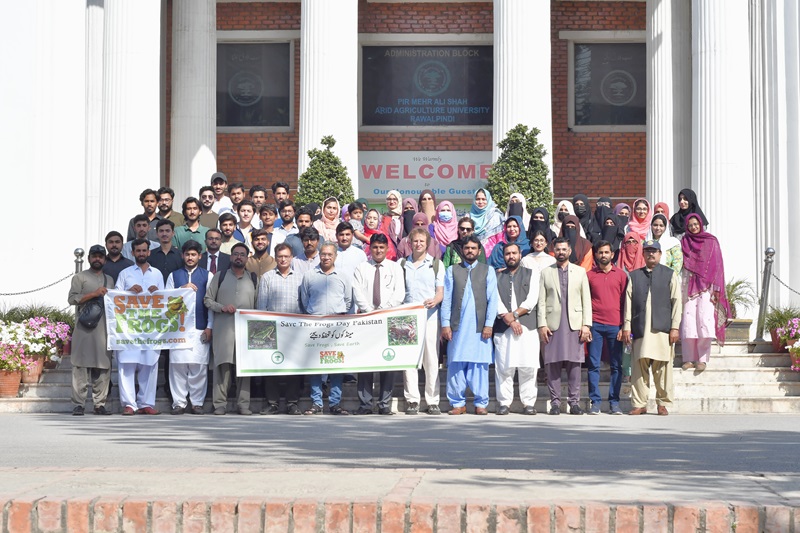
Participants in the inaugural session of Save The Frogs Day Pakistan on 25th April 2025 at PMAS-AAUR, Pakistan.

Field and Community Awareness Day

Location: District Chakwal and District Rawalpindi
Date: Saturday, 26th April 2025

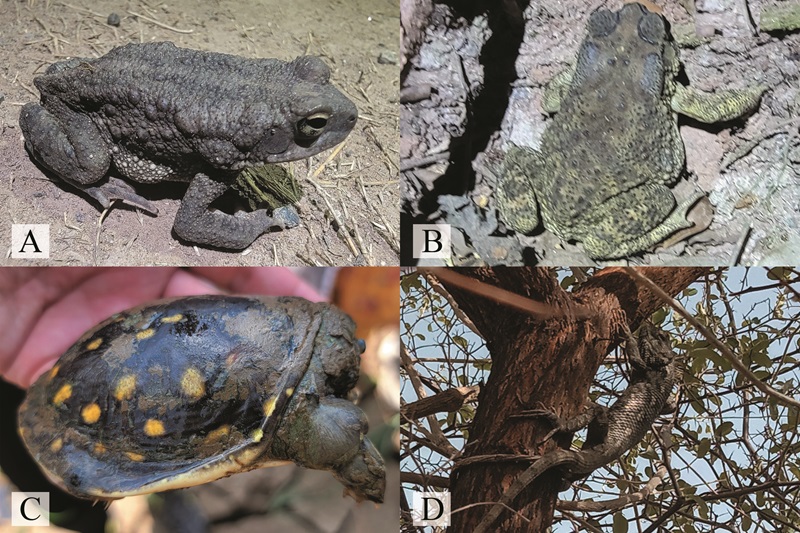
A team of young amphibian enthusiasts, including Dr. Muhammad Rais, Assistant Professor, Zoology Wildlife and Fisheries, PMAS-AAUR, and Prof. Dr. Amaël Borzée, conducted amphibian surveys and community education sessions in the agricultural landscapes of District Chakwal and District Rawalpindi. Locations included the University Research Farm (URF) in Koont, village sites in District Chakwal, and Rawal Dam, Islamabad. Observed amphibians were Skittering Frog (Euphlyctis adolfi), Pierre’s Wart Frog (Minervarya pierrei), Nilphamari Narrow-mouthed Frog (Microhyla nilphamariensis), Indian Bullfrog (Hoplobatrachus tigerinus), Marbled Toad (Firouzophrynus stomaticus), and Common Toad (Duttaphrynus melanostictus). Additionally, an Indian Flapshell Turtle (Lissemys punctata) was rescued from mud and safely released back into a pond.

The survey provided participants with hands-on experience in amphibian identification, habitat exploration, and public engagement, fostering future conservation initiatives.
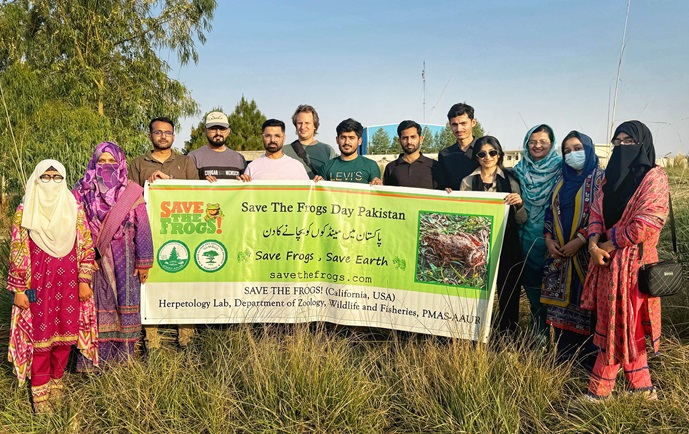
Group photo of participants during community awareness and field day on 26th April 2025 in District Rawalpindi.

Field Day

Location: District Rawalpindi
Date: Sunday, 27th April 2025

A team of 10 participants led by Prof. Dr. Amaël Borzée visited Misriot Dam, District Rawalpindi. Initial observations included Skittering Frog (Euphlyctis adolfi) and Marbled Toad (Firouzophrynus stomaticus) in agricultural fields. Further surveys recorded Pierre’s Wart Frog (Minervarya pierrei) and Nilphamari Narrow-mouthed Frog (Microhyla nilphamariensis). A key objective was to locate the Indian Bullfrog (Hoplobatrachus tigerinus), the largest frog species in Pakistan, to provide hands-on training in species identification and obtaining samples for molecular identification using oral swaps.
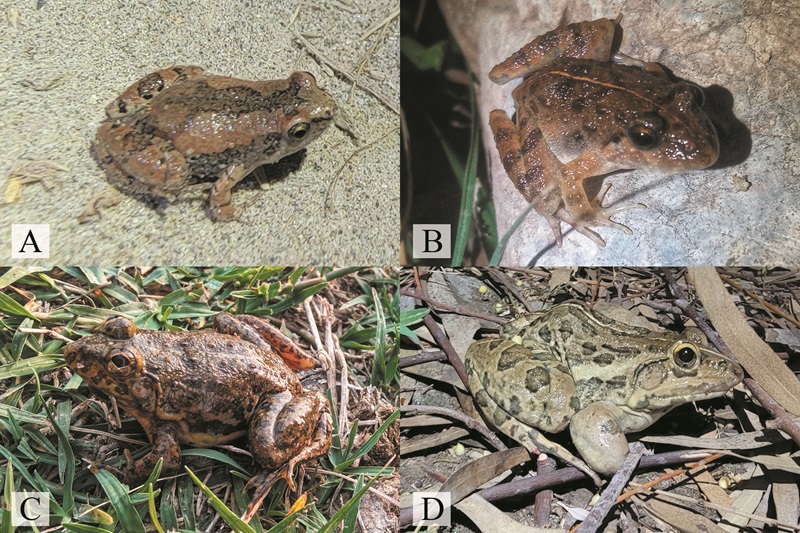
A. Nilphamari Narrow-mouthed Frog (Microhyla nilphamariensis); B. Pierre’s Wart Frog (Minervarya pierrei); C. Skittering Frog (Euphlyctis adolfi); D. Indian Bullfrog (Hoplobatrachus tigerinus). Photographers: Prof. Dr. Amaël Borzée (A, D); Ahmed Junaid (B, C).


A. Marbled Toad (Firouzophrynus stomaticus); B. Common Toad (Duttaphrynus melanostictus); C. Indian Flapshell Turtle (Lissemys punctata); D. Changeable Lizard (Calotes versicolor). Photographers: Prof. Dr. Amaël Borzée (A, B, C); Ahmed Junaid (D).

School Day

Location: GGHS Bilalabad, District Chakwal
Date: Monday, 28th April 2025

The School Day event was held at Government Girls High School (GGHS) Bilalabad. Students and teachers participated in a seminar featuring presentations on SAVE THE FROGS!, its global mission, grant opportunities, and ecotours. The session included an overview of local frog species, amphibian habitats, threats faced by amphibians in Pakistan and globally, and addressed common myths, emphasizing amphibians’ ecological importance.

Students engaged in a frog-themed drawing activity and were awarded certificates. The event concluded with group photos and refreshments. Participants were encouraged to act as local ambassadors for amphibian conservation.

Later, a final field survey in nearby agricultural areas recorded a Changeable Lizard (Calotes versicolor), various beetle species, and an Indian Bullfrog (Hoplobatrachus tigerinus).
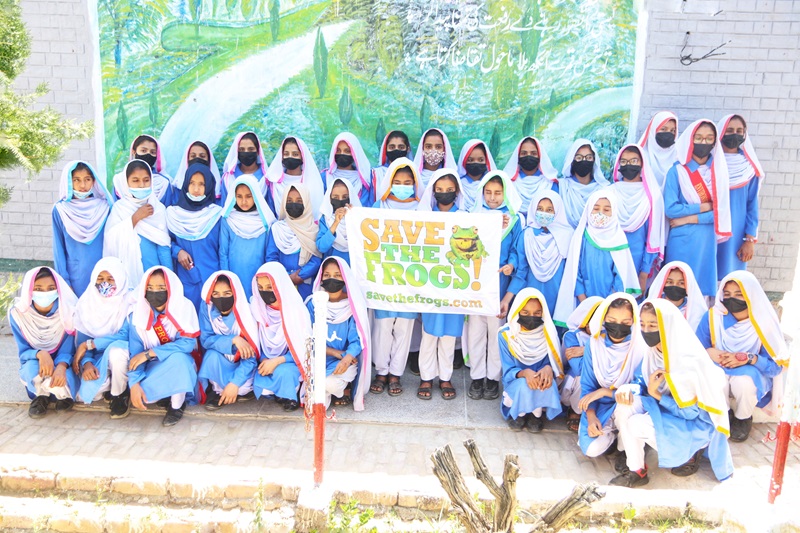

School students celebrating Save The Frogs Day on 28th April 2025 at GGHS Bilalabad, District Chakwal.

Seminar Day

Location: Trail 5, Margalla Hills National Park, Islamabad
Date: Saturday, 3rd May 2025

Miss Muzna Kashaf organized Save The Frogs Day at Trail 5, Margalla Hills National Park, in collaboration with SAVE THE FROGS!, Air Foundation School System, Islamabad Wildlife Management Board (IWMB), and Ministry of Climate Change and Environmental Coordination (MoCC&EC). Participants included 9th and 10th grade students from Air Foundation School System.

The seminar featured guest speakers Dr. Muhammad Rais, Sakhawat Ali (Deputy Director, IWMB), and Mr. Muhammad Jamil (Joint Secretary, MoCC&EC), who shared valuable insights into amphibian conservation. Activities included an awareness walk through amphibian habitats and a creative postcard-writing session advocating frog protection.

The event ended with distribution of souvenirs and refreshments, successfully raising awareness and inspiring youth to take responsibility for wildlife and ecosystem conservation.
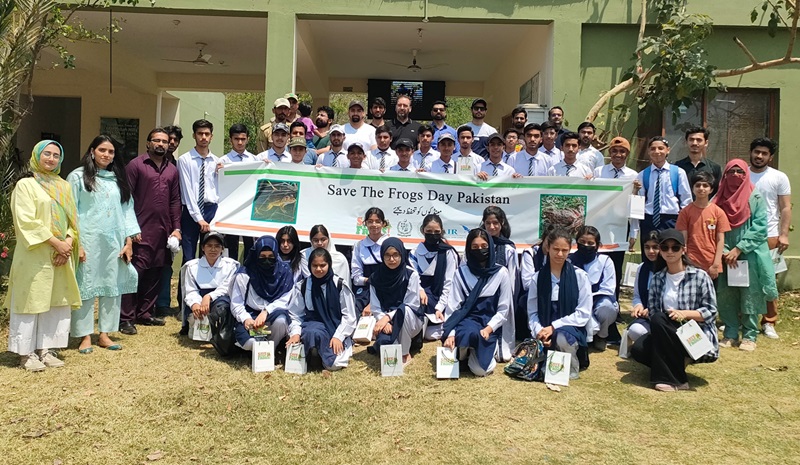
Participants celebrating Save The Frogs Day on 3rd May 2025 at Trail 5, Margalla Hills National Park.

Seminar Day

Location: University of Chakwal, Pakistan
Date: Tuesday, 13th May 2025

Miss Unza Waqar organized a Save The Frogs Day event aimed at raising amphibian conservation awareness in a region often overlooked in environmental dialogues. The event featured an academic seminar, awareness sessions, and a frog-themed art competition involving over 150 students and faculty.

These activities highlighted frogs’ ecological importance and the threats they face, including habitat loss and climate change. The event provided a rare platform for environmental discussion in a district with limited conservation exposure, emphasizing biodiversity’s significance in local ecosystems.

Together, these efforts raised awareness and inspired communities and students to actively conserve these vital but often overlooked species.
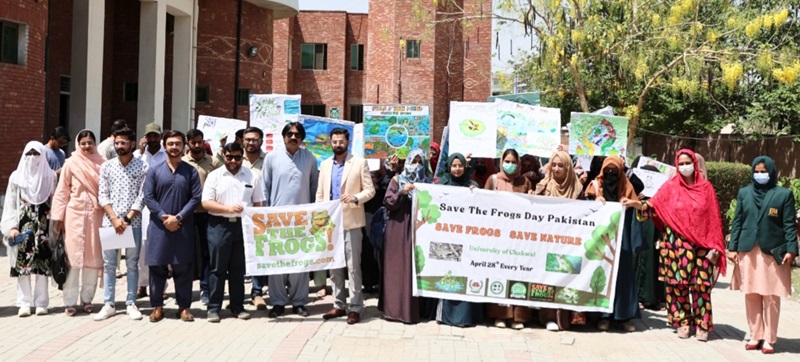
Students and faculty at University of Chakwal participating in Save The Frogs Day on 13th May 2025.

We are excited to share the news that our faculty member, Dr. Muhammad Rais, Assistant Professor in Wildlife Management, Department of Zoology, Wildlife and Fisheries, has co-authored a research article in Nature. The journal Nature is considered as the most esteemed multidisciplinary scientific journal (Impact factor 64.8). To date, only 99 research articles featuring scientists from Pakistan have been published in this journal. The study was also featured on Nature’s cover (Vol. 622, issue 7982, 12th October, 2023, attached). The paper can be downloaded by clicking here.

The Nature paper provides an update to the 2004 landmark paper that was based on the first global amphibian assessment for the IUCN Red List, which revealed the unfolding amphibian crisis for the first time and established a baseline for monitoring trends and measuring conservation impact. According to this new study, nearly 41% of all amphibian species that have been assessed are currently globally threatened, considered critically endangered, endangered or vulnerable. This is compared to 26.5% of mammals, 21.4% of reptiles and 12.9% of birds. The study also found that three out of every five salamander species are threatened with extinction primarily as the result of habitat destruction and climate change.

The assessment evaluated the extinction risk of more than 8,000 amphibian species from all over the world, including 2,286 species evaluated for the first time. More than 1,000 experts across the globe contributed their data and expertise, which found that two out of every five amphibians are threatened with extinction. These data will be published on the IUCN Red List of Threatened Species™.

The study was coordinated by the Amphibian Red List Authority, which is a branch of the International Union for Conservation of Nature’s Species Survival Commission’s Amphibian Specialist Group, hosted and managed by Re:wild. More than 100 researchers from > 130 institutions from the length and breadth of the world participated in this study.

Dr. Shamim Akhter, Associate Professor of Zoology won “Zoologist of the Year Award 2014”. The Zoological Society of Pakistan presented this award to Dr. Shamim Akhter in recognition of her outstanding contributions to Zoological Sciences. The ceremony was held during the inaugural session of 34th Zakariya University, Multan. Dr. M. H. qazi, Vice Chancellor, University of Lahore was the chief guest who honoured the award winners. Students and faculty members from different universities of Pakistan participated the conference. Pakistan Congress of Zoology held at Bahauddin

List of Instruments