
Dr. Muhammad Sajid Nadeem

Group Leader
Dr. Tariq Mahmood
Associate Professor (Tenured)
Member:
- IUCN SSC Pangolin Specialist Group (London)
- Society for Conservation Biology -Global and Asia Section
- Zoological Society of Pakistan (ZSP)
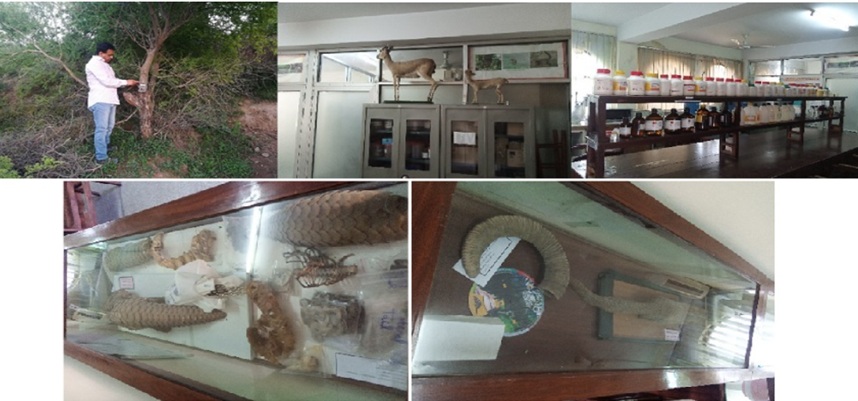
Introduction
The Research group “Mammalian Ecology and Conservation” is headed by Dr. Tariq Mahmood, Associate Professor (Tenured). The research group was established in 2010, with the aim to investigate the ecological parameters of the mammalian species of Pakistan for their conservation.
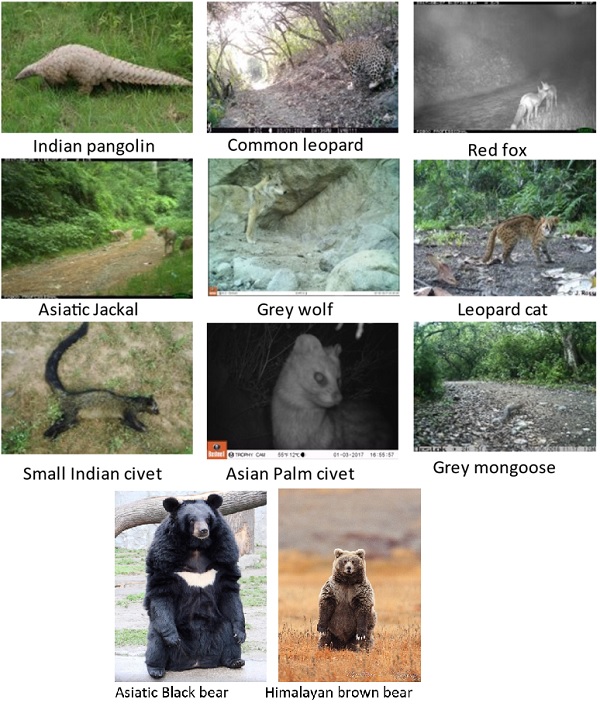
Some of the major animal Species being focused:
Indian pangolin (Manis crassicaudata), Common leopard (Panthera pardus), Grey wolf (Canis lupus), Red fox (Vulpes vulpes), Asiatic Jackal (Canis aureus), Black bear (Ursus thibetanus), Brown bear (Ursus arctos), Leopard cat (Prionailurus bengalensis), Small Indian civet (Viverricula indica), Asian palm civet (Paradoxurus hermaphroditus), Small Indian mongoose (Urva auropunctatus), Grey mongoose (Herpestes edwardsii).
PhD Scholars
| Sr. # | Scholar Name | Research Title | |
| 1 | Muhammad Farooq (09-arid-378) | Comparative Ecology and niche overlap of red fox (Vulpes vulpes) and Asiatic Jackal (Canis aureus) in Pothwar Plateau |  |
| 2 | Siddiqa Qasim (12-arid-718) | Genetic Variation, Population Ecology and Illegal Trade of Indian pangolin (Manis crassicaudata) in Azad Jammu & Kashmir, Pakistan |  |
| 3 | Mr. Muhammad Shakeel (21-arid-1322) | Effects of Land Use Change and Human Activity on Spatio-temporal Patterns of Mammalian Species in MHNP, Islamabad |  |
M.Phil. Scholars
| Sr. # | Scholar Name | Research Title | |
| 1 | Ms Hadiya Ramzan (18-arid-1437) | Estimation of cortisol from the faeces of Indian pangolin (Manis crassicaudata) |  |
| 2 | Ms. Saira Akber (22-arid-2169) | Distribution, diet and human conflict of apex predators in Khunjerab National Park |  |
| 3 | Ms. Shehnila Kanwal (22-arid-2545) | Diversity and relative abundance of mammalian fauna inhabiting Murree-Kotli Sattian-Kahuta National Park |  |
| 4 | Ms. Sania Areej (20-arid-1493) | Reconstructing and quantifying the past distribution range of Cheetah (Acinonyx jubatus) | |
| 5 | Ms. Hadeesa Rubab (22-arid-2158) | Estimating past and current distribution range of barking deer (Muntiacus vaginalis) | |
| 6 | Ms. Bibi Sumaira (19-arid-2594) | Global distribution rage of golden jackal (Canisaureus) |  |
The mammalian Ecology and Conservation Lab is collaborating with different national and international organizations/ Universities for research activities and students exchange Program. The list includes provincial Wildlife Departments, international NGO’s and foreign universities. In this context one of our PhD students (Hira Fatima) visited University of California (UC) Davis, USA in 2018 for molecular analysis of her research samples. In return, on of the PhD scholar (Lauren Mae Hennelly) from UC Davis visited our lab (MECL) PMAS-AAUR in 2019 to collect her research samples from northern areas of Pakistan. Our Lab has also signed MoU’s with these collaborating organizations for research activities and joint research publications. Our lab is collaborating with WWF Pakistan Islamabad office for research on Indian pangolin ecology and Illegal Wildlife Trade. Islamabad Wildlife Management Board (IWMB) MHNP islamabad, is facilitating our research students in data collection from the Margalla Hills national Park islamabad regarding their M.Phil. and PhD thesis. We have also jointly published research articles in peer reviewed journals. The Forest, Wildlife and Environment Department, Gilgit-Baltistan (G.B.) is collaborating with our lab for collecting scat samples of grey wolf from the northern areas. Similarly, Abbottabad Wildlife Division has been collaborating with us for scat collection and camera trapping regarding Red fox from Ayubia National Park. The Mardan Wildlife office of the KP Wildlife Department is collaborating with us in the field study and data collection and community awareness program regarding Indian pangolin Conservation in Mardan District.
| 1 | IUCN SSC Pangolin Specialist Group c/o Zoological Society of London, Regent’s Park, London, England, NW1 4RY |  |
| 2 | University of California (UC), Davis, CA 95616, USA. |  |
| 3 | “1Stop Borneo Wildlife”, Sarawak / Saba , Malaysia https://www.1stopborneo.org/ |  |
| 4 | Punjab Wildlife and Parks department, Government of the Punjab, 1-Sanda Road, Lahore. |  |
| 5 | Khyber Pakhtunkhwa (KP) Wildlife Department, Peshawar. |  |
| 6 | Forest, Wildlife and Environment Department, Gilgit-Baltistan (G.B.) |  |
| 7 | World-wide Fund for Nature (WWF) Pakistan, Ground Floor, Pakistan Academy of Sciences Building, Constitution Avenue, Islamabad, Pakistan |  |
| 8 | Islamabad Wildlife Management Board (IWMB), MHNP Islamabad |  |
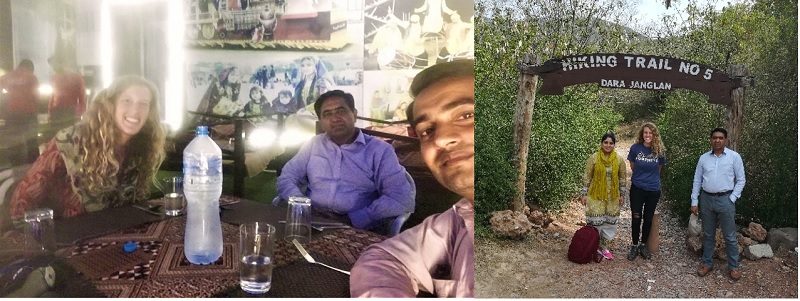
We are applying traditional as well as modern techniques to collect data on wildlife species and study their different ecological aspects. We are also focusing on collecting data about different carnivore species including common leopard, gray wolf, black bear etc. which are in conflict with human in different areas of the country. Mainly we are using:
Field Surveys
we conduct field surveys to different study areas (individual and in groups) for data collection about all mammalian wildlife species understudy. These surveys are made for 1 day to one week in a particular area. The surveys range from weekly, to fortnightly to monthly frequency. During field surveys we use field equipment including binoculars, spotting scope, handheld GPS device etc. to collect data.
Bioacoustic Surveys
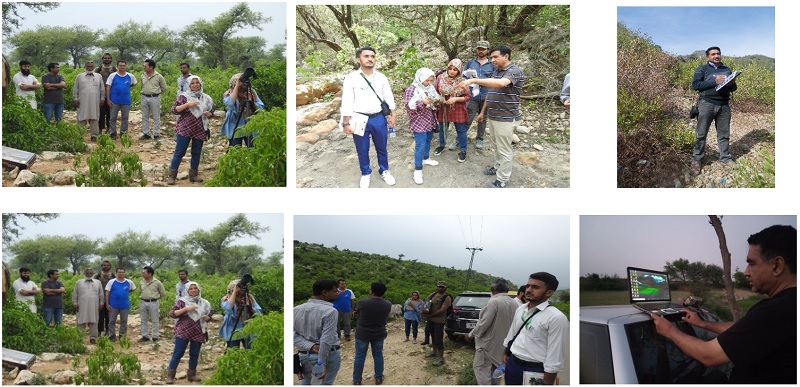
We are also performing bioacoustic surveys in the field for Asiatic Jackal population in the Pothwar Plateau. The use of bioacoustics as a non-invasive and cost-effective sampling method has greatly increased worldwide more recently. This method has been practiced for brds, and bats in the field. In our surveys, we are using this technique to collect data on Asiatic Jackal. For bats, acoustic surveys have long been known to complement traditional mist-netting. Bioacoustic surveys can be used to capture useful and robust data on vocalisations or howling of canid species, in our case, Asiatic Jackal, to inform studies on carnivore distribution and ecology. During this technique, we play loudly the recorded sound of howling of Jackals through a megaphone that spreads across the environment. The Jackals present in that area listen to this recorded sound and respond singly, or in group, tha gives us the numbers of Jackals present in that area.
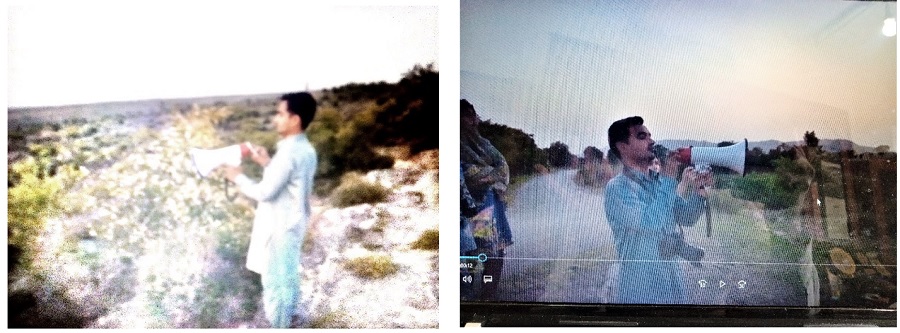
Field photographs showing application of Bioacoustic survey for Asiatic Jackal data collection.
Camera Trapping
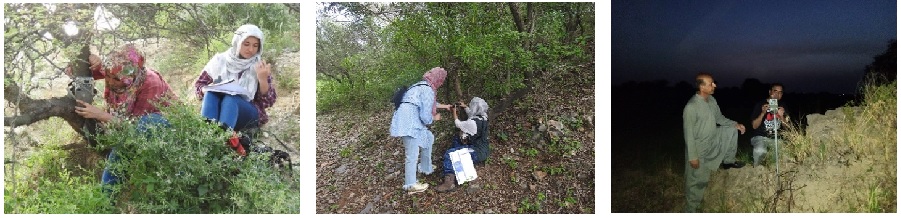
Motion-triggered trail cameras are being used to investigate and confirm the presence or occurrence of a species in an area, to estimate the abundance of a species in an area And to study the mammalian diversity of an area.
Radiotelemetry
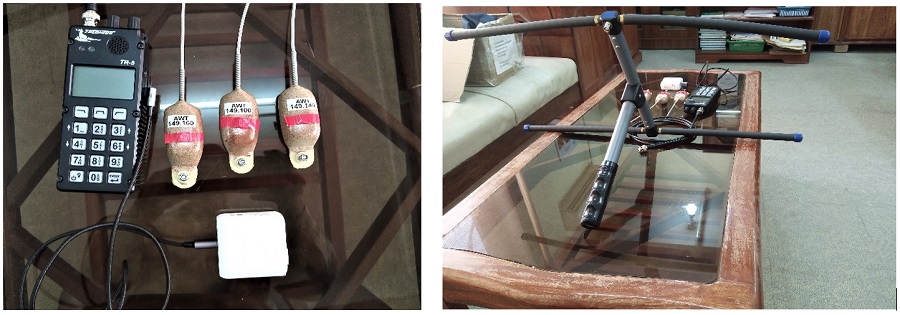
This technique is used for studying the home range of a mammalian species. Now our lab has been successful to acquire radio transmitters, and receivers from an international organization “1Stop Borneo Wildlife” for our Indian pangolin study project.
Scat Analysis
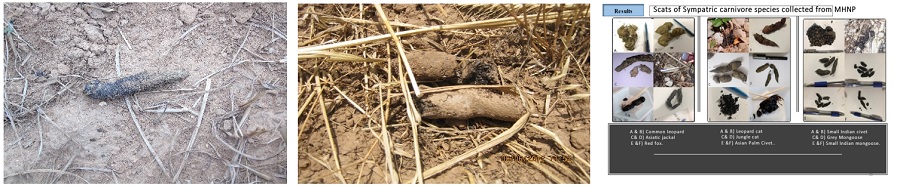
Our lab is conducting studies on investigating food habits of different mammalian and carnivores, especially. The aim is to know about the kind of diet a species is using, and the prey species it is consuming in an area. This method provides information about the human -wildlife conflict as well in an area. The scat of mammals and especially carnivores are collected from the field periodically, identified in the field on the basis of their shape, color and type of material they contain, collected in self-sealing polythene bags along with all details like GPS location, identified species, date, time and site name etc. and brought to the laboratory for analysis.
Molecular analysis of scats
The mammalian or carnivores’ scats collected from the field are analyzed in the lab for food habits and prey species. Along with that these collected scats are also preserved in the ethanol for their DNA study and molecular analysis. The species DNA is extracted and sequenced from the scats and identified for species identification and phylogenetic analysis.
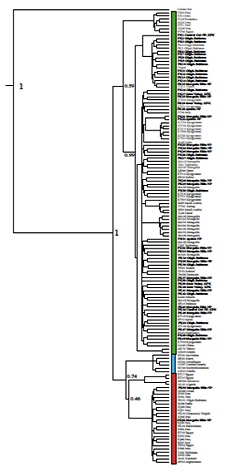
Figure 3: Phylogenetic tree of 140 red foxes using 304bp of the mitochondrial cytochrome B sequence. The posterior probability is indicated at the relevant node positions. The tip labels refer to the sample IDs in Table S1 with labels in black indicated newly sequenced samples from this study. Red bar indicates the Palearctic maternal lineage, blue indicates Nearctic maternal lineage, and green indicates Holarctic maternal lineage. KPK = Khyber Pakhtunkhwa administrative province in Pakistan, NP = National Park.
Geographical Information System (GIS) analysis
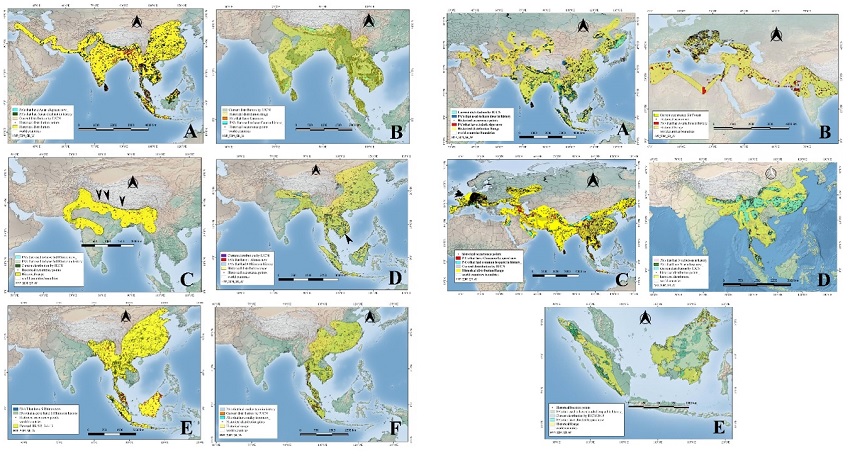
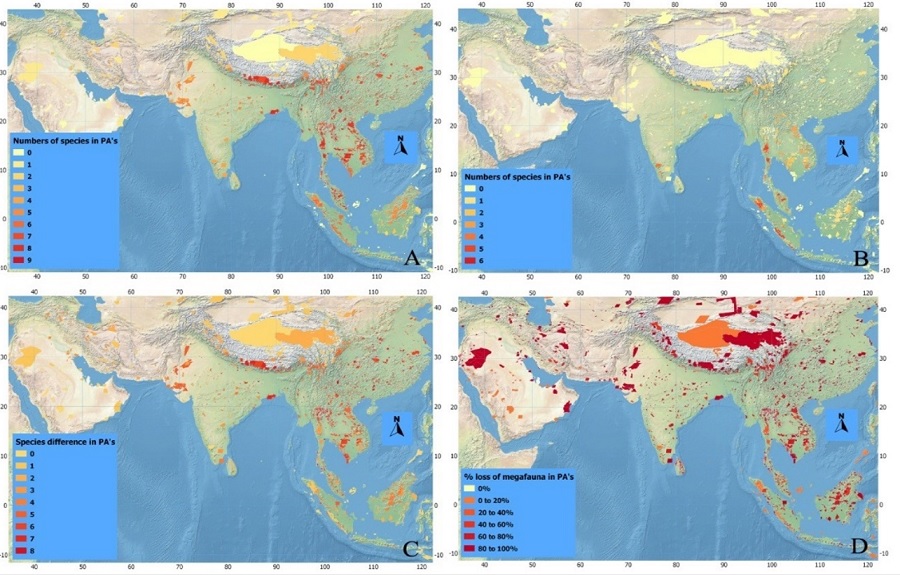
We are also using GIS software to construct maps of different species distribution in the country and at global level. We are also reconstructing the global historical distribution of the mammalian species using Quantum Geographical System (QGIS) software. Up till now we have successfully studied and published the historical distribution maps of mammalian species including snow leopard (Panthera uncia), common leopard (Panthera pardus), gray wolf (Canis lupus), brown bear (Ursus arctos), Asiatic lion (Panthera leo), Asiatic tiger (Panthera tigris), Asian elephant (Elephas maximus), three Rhino species (Indian, Javan and Sumatran rhino) and Malay tapir etc.
Questionnaires Surveys
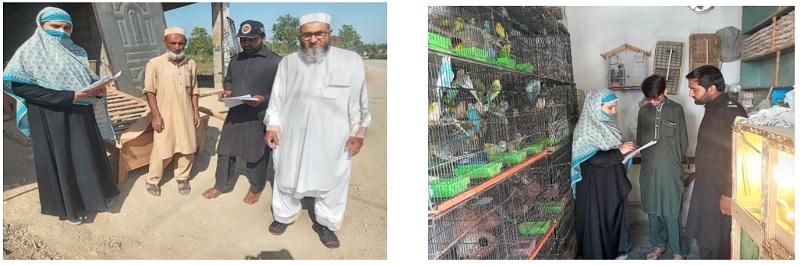
We are also using indirect method of questionnaire survey to collect data from local people/ community about different aspects of a conflict species in an area. We use self-designed questionnaire proforma to get filled at the time of interview with local community in n area. The data is analyzed to study the different aspects of a conflict species.
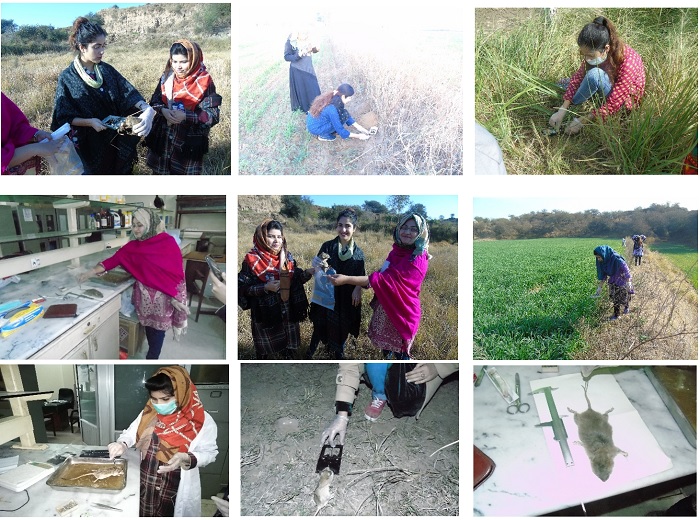
Rodents studies
We are also conducting field and laboratory stududies to investigating different ecological aspects of various rodent species occurring in the Pothwar Plateau. Rodents, being pest species cause huge economic losses to wheta, groundnut etc. and farmers need to controll the population of these pest species. We collect dta on rodents reproductive cycles, the type of crop they damage, and the control measures to be taken. The farmers are accordingly advised how they can control these pest species in their crop field. They are also provided with the bait and traps to capture and control the rodents. The rodent’s species focused so far include lesser bandicoot rat (B. bengalensis), the short-tailed mole rat (N. indica), the Indian gerbil (T. indica) and the bush rat (G. ellioti).
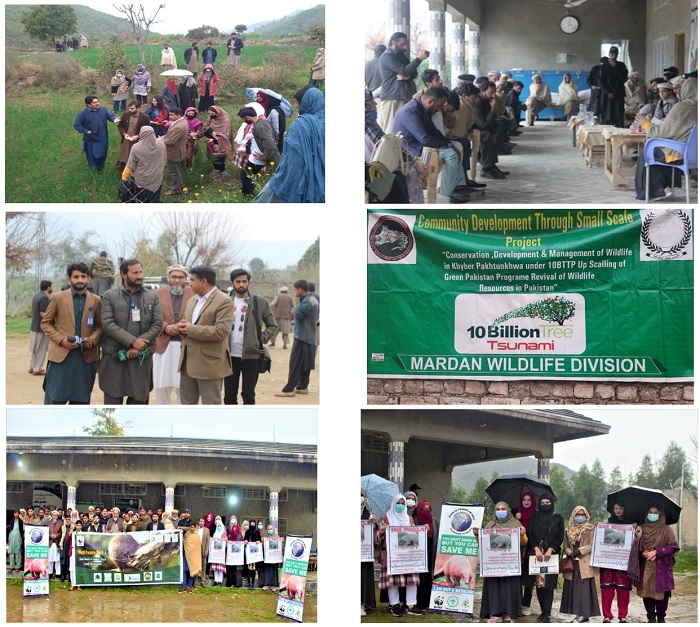
We also approach local communities in their area, which are living in the vicinity of different wildlife species which are in conflict with human (common leopard, black bear, grey wolf, etc.), or those wildlife species which are being poached and illegally killed for getting financial benefits such as Indian pangolin.
We invite communities and conduct seminars in their area, asking about their conflict with any particular wildlife species, and providing them with the information how to solve the issue. We brief the local people about the ecological importance of the particular wildlife species and how to avoid the conflict. In this regard we collaborate with the provincial wildlife departments staff like Punjab Wildlife and Parks department, Khyber Pakhtunkhwa Wildlife Department, Islamabad Wildlife Management Board Islamabad etc. We have already conducted community surveys and visited many areas of conflict including Chakwal, Kahuta-Kotli Sattian, Mardan district, Kotli district (AJ&K) Margalla Hills National Park Islamabad etc.
A number of Research projects have been completed and are in progress focusing on different aspects of the mammal species in the country. Funding agencies targeted include Higher Education Commission (HEC) Pakistan), Rufford small Grants Program, IDEA WILD, PMAS-AAUR Endowment Fund. Details of the project are given below:
| Sr. # | Title of Research Project | Duration | Role | Funding Agency | Amount/worth (Rs.) | Status |
| 1 | Promoting responsible tourism, and conserving Cultural Heritage and pangolin population in CPEC-routed areas of Khyber Pakhtunkhwa (KP), Pakistan | 02 years | CO-PI | HEC-CPEC CRG (Consortium) | Rs. 23,165,050/- | Submitted online on May 30, 2022 |
| 2 | Comparative ecology and niche overlap of red fox (Vulpes vulpes) and Asiatic jackal (Canis aureus) in Pothwar Plateau | 01 year | Principal Investigator (PI) | ORIC-PMAS AAUR, Rawalpindi | Rs. 0.2 million | Awarded in Feb. 2022 |
| 3 | “Ecologically based rodents’ management in crop lands of Pothwar Plateau”. | Originally 3 years | As PI: Dr. Tariq Mahmood | HEC Islamabad | 7.596 million | Completed in December 2019 and submitted final Reports to HEC Islamabad |
| 4 | Comparative ecology and niche overlap of red fox (Vulpes vulpes) and Asiatic jackal (Canis aureus) in Pothwar Plateau | One year | PI: Dr. Tariq Mahmood | PMAS-AAUR/ORIC/Endowment funds for PhD Studies | Rs. 200,000/- | Started March 2022- In progress |
| 5 | Range quantification of Indian pangolin (Manis crassicaudata) | 01 year Oct. 01, 2020, to 30 September 2021 | As PI: Dr. Tariq Mahmood | IDEA WILD | Dell XPS 15 9570 Laptop awarded | Awarded in 2020-2021 |
| 6 | Occupancy, Home Range estimation and Community –based Conservation of Indian pangolin (Manis crassicaudata) in Pothwar Region, Pakistan | 03 Years | As PI: Dr. Tariq Mahmood | Chicago Zoological Society Chicago Board of Trade Endangered Species Fund (USA) | USD 5000 | Submitted to Chicago Zoological Society, USA |
| 7 | Feeding Patterns, Fruit Damage Assessment and Strategies to Resolve Human-Small Kashmir Flying Squirrel conflict in District Bagh, Poonch and Sudhnutti, Azad Jammu and Kashmir | 03 Years | As Co-PI | HEC Islamabad | Rs. 1.780,348 million | On-going : Awarded by HEC Islamabad |
| 8 | “Developing Reproductive technologies for Conserving Quail” | 03 Years | As Co-PI PI Dr. Bushra AR | HEC Islamabad | Rs.8.375187 million | On-going |
| 9 | “Assessing the status and distribution of wolves in Pakistan using genetics” | 01 year | As Co-PI PI: Hira Fatima | Rufford Small Grants International | £4914 | Completely successfully in 2018 |
| 10 | “Ecology of Indian pangolin (Manis crassicaudata) in Potohar Region”. | 03 years | PI | HEC Islamabad | Rs. 2.158 million/-. | Completed successfully in March 2014 |
| 11 | “Captive breeding and rearing wild and fancy birds” | 01 Year | PI | ORIC-PMAS-AAUR | Rs. 296,00/- | Completed successfully in 2017 |
| 12 | Distribution and population of Indian pangolin (Manis crassicaudata) in Chakwal and Rawalpindi Districts of Potohar Region. | 01 Year | PI | ORIC-PMAS-AAUR | Rs. 132,312/- | Completed in March 2011 |
| 13 | “Population and food habits of small Indian Mongoose in the Potohar Region” | 01 Year | PI | ORIC-PMAS-AAUR | Rs. 94000/- | Completed in June 2009 |
Indian pangolin (Manis crassicaudata)
We hereby proudly share that the current IUCN Redlist of Threatened species: Indian pangolin was published in 2019 and is owned by our lab “Mammalian Ecology and Conservation Lab” The first author in this list and the third author, both belong to this lab.
| Sr. # | Name | Research Title | Year awarded | Picture |
| 1 | Nausheen Irshad | Population, Distribution and Food Habits of Indian pangolin (Manis Crassicaudata) in Potohar Plateau, Pakistan. | June 01, 2015 |  |
| 2 | Riaz Hussain | Comparative Ecology of two mongoose species (Herpestes javanicus and H. edwardsii) inhabiting Pothwar Plateau. | Dec. 2017 |  |
| 3 | Shaista Andleeb | Chromium toxicity in small Indian mongoose (Herpestes javanicus) inhabiting Tannery areas of Kasur District, Pakistan | July 19, 2018 |  |
| 4 | Faraz Akrim | Resource partitioning among sympatric carnivore species at Pir Lasura National Park, Azad Jammu and Kashmir. | September, 2018 |  |
| 5 | Hira Fatima | Diet composition and niche breadth of sympatric carnivores of Margalla Hills National Park, Islamabad, Pakistan | September, 2020 |  |
| 6 | Nadeem Munawar | Damage assessment and control of rodents in Agro-ecosystems of Pothwar Plateau, Pakistan | Feb. 2021 |  |
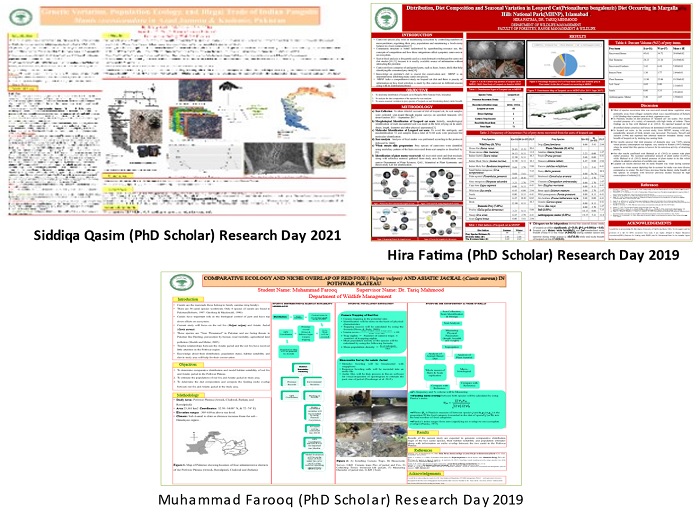
The PhD and M.Phil. research scholars of the lab present their work in the form of posters inside and outside the university at different occasions like “Research Day”, conferences etc. A few notable posters are given below:
Field equipment
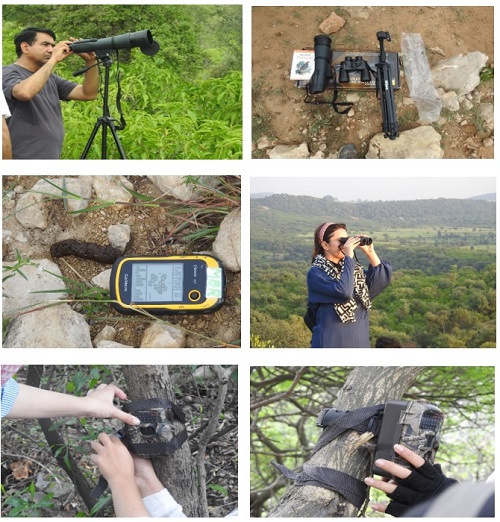
We use necessary field equipment for data collection in the field, mainly including
- Global Positioning System (GPS)
- Spotting Scope
- Motion-triggered Camera Traps
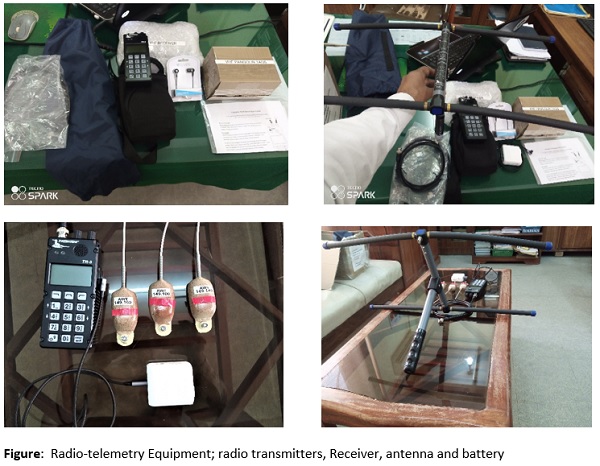
Radio-telemetry equipment
Radio-telemetry apparatus we have received from “1StopBorneo Wildlife” an international organization based in Malaysia working for Wildlife Conservation. This equipment is particularly obtained for conducting radio-telemetry studies on Indian pangolin, for determining its home range. In this apparatus, the radio-transmitters are attached to the dorsal side scales of Indian pangolin which emit signals which are tracked using a receiver. The antenna of the apparatus helps in locating and tracking the signals emitted by the tag / transmitter attached to the pangolin. The beep of the receiver helps to move in the direction and follow the tagged animal, the pangolin going ahead.
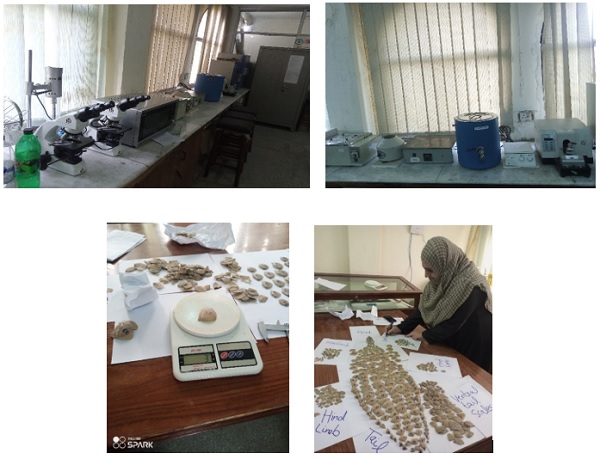
Major Lab apparatus
Being used include light microscopes, centrifuges, Water bath, heating oven, slide warmer, Microtome, wax Dispenser, Dissection apparatus, refrigerator, deep freezer (sample storage)
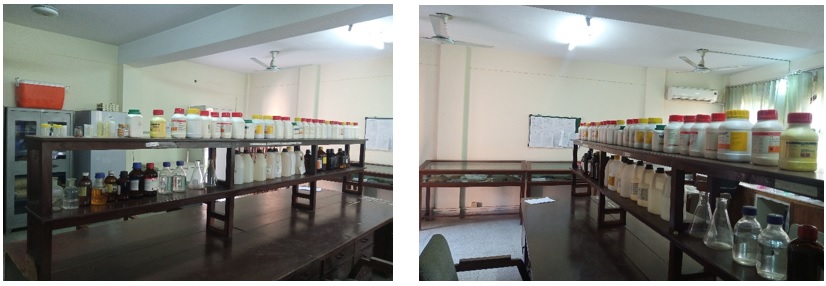
Lab Chemicals
For food habits investigation of mammalian species (Scat analysis), light microscopy, sample storage (formalin, ethanol, etc.) are also available in the lab
The mammalian Ecology and Conservation lab since its establishment 2010 has successfully published a total of 115 Research articles in peer Reviewed international Journals, making its research work available to scientific community.
List of Recent publications
- Muhammad Danish, Tariq Mahmood, Faraz Akrim, Muhammad Sajid Nadeem, Shumaila Noreen, Nadeem Munawar , Muhammad Shaki , Muhammad Arshad. 2023. Spatio-temporal patterns of human-carnivore conflict and mitigation in Pakistan. Journal for Natural Conservation. 76 (2023) 126479. DOI: https://doi.org/10.1016/j.jnc.2023.126479. (IF: 2.575)
- Faraz Akrim , Tariq Mahmood , Jerrold L. Belant , Muhammad Sajid Nadeem , Siddiqa Qasim ,Tashi Dhendup , Hira Fatima , Syed Afaq Bukhari , Asad Aslam , Humera Younis , Aamish Rafique , Zahid Ahmed Subhani , Shafqaat Ahmed Hashmi and Nadeem Munawar. 2023. Niche partitioning by sympatric civets in the Himalayan foothills of Pakistan. PeerJ 11: e14741 DOI 10.7717/peerj.14741 . (IF: 3.061)
- Faraz Akrim, Neelum Khursheed, Jerrold L. Belant, Tahir Mehmood, Tariq Mahmood, Aamish Rafique, Siddiqa Qasim, Alina Mushtaq, Sanwal Aslam, Zahid Ahmed Subhani, Uzma Habib, Shafqaat Ahmed Hashmi, Asad Aslam, Nadeem Munawar. 2023. Patterns, Costs, and Drivers of Livestock Depredations by Leopards, in Rural Settlements of Pakistan. Global Ecology and Conservation (GECCO): In Press: (2023).doi: https://doi.org/10.1016/j.gecco.2023.e02564. (IF: 3.969)
- Lauren M. Hennelly*, Ghulam Sarwar, Hira Fatima, Geraldine Werhahn, Fakhar I. Abbas, Abdul M. Khan, Tariq Mahmood, Shannon Kachel, Zairbek Kubanychbekov, Muhammad T., Waseem, Rubab Zahra Naqvi, Abdul Hamid, Yasir Abbas, Hamera Aisha, Muhammad Waseem, Muhammad Farooq, Benjamin N. Sacks. 2023. Genomic analysis of wolves from Pakistan clarifies boundaries among three divergent wolf lineages. Journal of Heredity. 2023, XX, 1–10. DOI: esad066, https://doi.org/10.1093/jhered/esad066. (IF: 2.679)
- Hira Fatima, Tariq Mahmood, Lauren M. Hennelly, Muhammad Farooq, Nadeem Munawar, Mohammad Wajid & Benjamin N. Sacks. 2023. Distributional patterns and habitat association of sympatric carnivores in Margalla Hills National Park, Pakistan, and a comparison of conventional vs molecular identification in carnivore scatology. Animal Biology (2023) DOI 10.1163/15707563-bja10116. (IF: 1.227)
- Gul Saba, Tariq Mahmood, Nadeem Munawar, Faraz Akrim, Asma Khalid, Muhammad Sajid Nadeem. 2023. Narrow range of suitable habitat and poaching driving Indian pangolin (Manis crassicaudata) towards extirpation in Mardan District, Pakistan. Hystrix (Accepted): manuscript HYSTRIX-00616-2023-01. (IF: 1.796)
- Tariq Mahmood, Shaukat Ali, Nadeem Munawar, Faraz Akrim, Hira Fatima, Muhammad Waseem, Nausheen Irshad, Zeeshan Khalid, Muhammad Farooq. 2023. Dietary habits and human conflict of Asiatic black bear (Ursus thibetanus) in Bajaur Agency, Pakistan. URSUS (Accepted). MS ID: URSUS -D-23-0000R1. (IF: 1.25)
- Siew Woh Chooa,b,⁎, [email protected], Ju Lian Chongc,d,⁎⁎, [email protected], Philippe Gauberte, Alice Catherine Hughes, Stephen O’Brieng,, Anne-Lise Chaber, Agostinho Antunes, Sara Plattol, Nick Ching-Min Sun, Li Yun, Klaus-Peter Koepflig, Tulshi Laxmi Suwal , Mukesh Thakur, Stephan Ntie, Elisa Panjangd, Jayaraj Vijaya Kumaran, Tariq Mahmood etc. 2022. A collective statement in support of saving pangolins. Science of the Total Environment. Science of the Total Environment (STOTEN): 153666. (IF: 7.963)
- Tariq Mahmood, Shakeela Ismail, Faraz Akrim, Muhammad Farooq, Nadeem Munawar, and Muhammad Raza Khan. 2022. Diet composition of grey wolf (Canis lupus) varies seasonally in Deosai National Park, Gilgit-Baltistan, Pakistan. Pakistan Journal of Zoology. 54(5): 2267-2275. DOI: https://dx.doi.org/10.17582/journal.pjz/20210406040405. (IF: 0.687)
- IUCN SSC Pangolin Specialist Group. 2021. Guidance for first responders on the short-term care of confiscated pangolins. IUCN SSC Pangolin Specialist Group, c/o Zoological Society of London, Regent’s Park, London, NW1 4RY, UK
- Misbah Bint Riaz, Faraz Akrim, Siddiqa Qasim, Syed Afaq Bukhari, Asad Aslam, Muhammad Waseem, Rizwana Imtiaz and Tariq Mahmood. 2021. First camera trap photographs of Indian Pangolin Manis crassicaudata (Mammalia: Pholidota: Manidae) from Pakistan. Journal of Threatened Taxa. 26 July 2021 | 13(8): 19156–19158. https://doi.org/10.11609/jott.7508.13.8.
- Hira Fatima, Tariq Mahmood, Lauren Mae Hennelly, Muhammad Farooq, Faraz Akrim and Muhammad Sajid Nadeem. 2021. Spatial distribution and dietary niche breadth of leopard cat (Prionailurus bengalensis) inhabiting Margalla Hills National Park, Pakistan. Zoological Studies 60: 34 doi:10.6620/ZS.2021.60-34 (IF: 2.058 )
- Tariq Mahmood, Tuong Thuy Vu, Ahimsa Campos-Arceiz, Faraz Akrim, Shaista Andleeb, Muhammad Farooq, Abdul Hamid, Nadeem Munawar, Muhammad Waseem, Abid Hussain, Hira Fatima, Muhammad Raza Khan. 2021. Historical and current distribution ranges and loss of mega-herbivores and carnivores of Asia. PeerJ 9: e10738 DOI 10.7717/peerj.10738. (IF: 2.984)
- Shaista Andleeb, Zulfiqar Ahmad, Tariq Mahmood, Shenxu Bao, Abdullah A Saeed and Sunil K Jha. 2020. Evaluating toxicity impacts of environmental exposed chromium on small Indian mongoose (Urva auropunctatus) hematological, biochemical and histopathological functioning. Chemosphere 259 (2020) 127485. DOI: https://doi.org/10.1016/j.chemosphere.2020.127485 (IF: 7.086)
- Muhammad Waseem, Barkatullah Khan, Tariq Mahmood, Hafiz Sajid Hussain, Rizwana Aziz, Faraz Akrim, Tariq Ahmad, Rabia Nazir, Shoaib Hameed, and Muhammad Naeem Awan. 2020. Occupancy, habitat suitability and habitat preference of endangered Indian pangolin (Manis crassicaudata) in Potohar Plateau and Azad Jammu and Kashmir, Pakistan. Global Ecology and Conservation 23 (2020) e01135. (IF: 3.380)
- Hira Fatima, Tariq Mahmood, Sakhawat Ali, Faraz Akrim, Muhammad Farooq and Shaista Andleeb. 2020. Sympatric mongoose species may opt for spatial adjustments to avoid feeding competition at Margalla Hills National Park Islamabad, Pakistan. Wildlife Biology. 2020 wlb. 00654. DOI: 10.2981/wlb.00654. (IF:1.474)
- Mahmood, T., Challender, D., Khatiwada, A., Andleeb, S., Perera, P., Trageser, S., Ghose, A. & Mohapatra, R. 2019. Manis crassicaudata. The IUCN Red List of Threatened Species 2019: e.T12761A123583998.https://dx.doi.org/10.2305/IUCN.UK.2019- 3.RLTS.T12761A123583998.en. Downloaded on 11 February 2020.
- Tariq Mahmood, Ayesha Younas, Faraz Akrim, Shaista Andleeb, Abdul Hamid, & Muhammad Sajid Nadeem. 2019. Range contraction of Snow Leopard (Panthera uncia). PLoS One 14(8): e0218460. https://doi.org/10.1371/journal.pone.0218460. (IF: 3.240)
- Abdul Hamid, Tariq Mahmood*, Hira Fatima, Lauren Mae Hennelly, Faraz Akrim, Abid Hussain and Muhammad Waseem. 2019. Origin, ecology and human conflict of gray wolf (Canis lupus) in Suleman Range, South Waziristan, Pakistan. Mammalia. 83 (6): DOI: https://doi.org/10.1515/mammalia- 2018-0167. (IF: 0.944)
- Tariq Mahmood, Faraz Akrim, Nausheen Irshad, Riaz Hussain, Hira Fatima Shaista Andleeb and Ayesha Aihetasham. 2019. Distribution and illegal killing of Endangered Indian pangolin (Manis crassicaudata) in Potohar Plateau, Pakistan. Oryx. 53(1): 159-164. (IF: 2.693)
- Shaista Andleeb, Tariq Mahmood and Azeem Khalid. 2019. Environmental chromium from tannery industry induces altered reproductive endpoints in wild female small Indian mongoose (Urva auropunctatus). Toxicology and Industrial Health. DOI: 10.1177/0748233718814975 (IF: 2.273)
- Faraz Akrim, Tariq Mahmood, Muhammad Sajid Nadeem*, Tashi Dhendup**, Hira Fatima, and Shaista Andleeb. 2019. Diet composition and niche overlap of two sympatric carnivores; Asiatic jackal (Canis aureus) and Kashmir hill fox (Vulpes vulpes griffithii), inhabiting Pir Lasura National Park, north-eastern Himalayan Region, Pakistan. Wildlife Biology. 2019 (1): DOI: https://doi.org/10.2981/wlb.00440. (IF: 1.474)
- Abid Hussain, Tariq Mahmood, Faraz Akrim, Shaista Andleeb, Hira Fatima, Abdul Hamid and Muhammad Waseem. 2019. Depleting wild prey compels common leopard (Panthera pardus) to sustain on livestock. Animal Biology. 69: 213-230. DOI 10.1163/15707563-17000161. (IF: 1.475)
- Faraz AKRIM, Tariq MAHMOOD, Muhammad Sajid NADEEM*, Shaista ANDLEEB and Siddiqa QASIM. 2018. Spatial distribution and dietary niche breadth of the leopard Panthera pardus (Carnivora: Felidae) in North- Eastern Himalayan region of Pakistan. Turkish Journal of Zoology. 42: 585-595. (IF: 0.673 )
- Faraz Akrim, Tariq Mahmood, Tamara Max, Muhammad Sajid Nadeem, Siddiqa Qasim and Shaista Andleeb. 2018. Assessment of Bias in morphological identification of carnivore scats confirmed with molecular scatology in north-eastern Himalayan region of Pakistan. PeerJ. DOI 10.7717/peerj.5262. (IF: 2.984)
- Shaista Andleeb, Tariq Mahmood, Azeem Khalid, Faraz Akrim, and Hira Fatima. 2018. Hexavalent chromium induces testicular dysfunction in small Indian mongoose (Herpestes javanicus) inhabiting tanneries area of Kasur District, Pakistan. Ecotoxicology and Environmental Safety. 148 (C ): 1001-1009. (IF: 6.291)
- Faraz Akrim, Tariq Mahmood, Shaista Andleeb, Riaz Hussain and Wendy Jane Collinson. 2019. Spatio-Temporal Patterns of Wildlife Road mortality in Pothwar Plateau, Pakistan. Mammalia (aop): DOI: https://doi.org/10.1515/mammalia-2017-0101. (IF: 0.944)
